Octave
The Octave is a complementary solution for enhancing the OPX capabilities by up- and down-converting its analog outputs, creating a seamless RF front-end OPX. With the Octave, one can have up to five RF outputs and two combined RF inputs operating in a frequency band of 2GHz to 18GHz. The following page describes Octave's block diagram and port specifications. For a detailed user manual, see the Octave guide
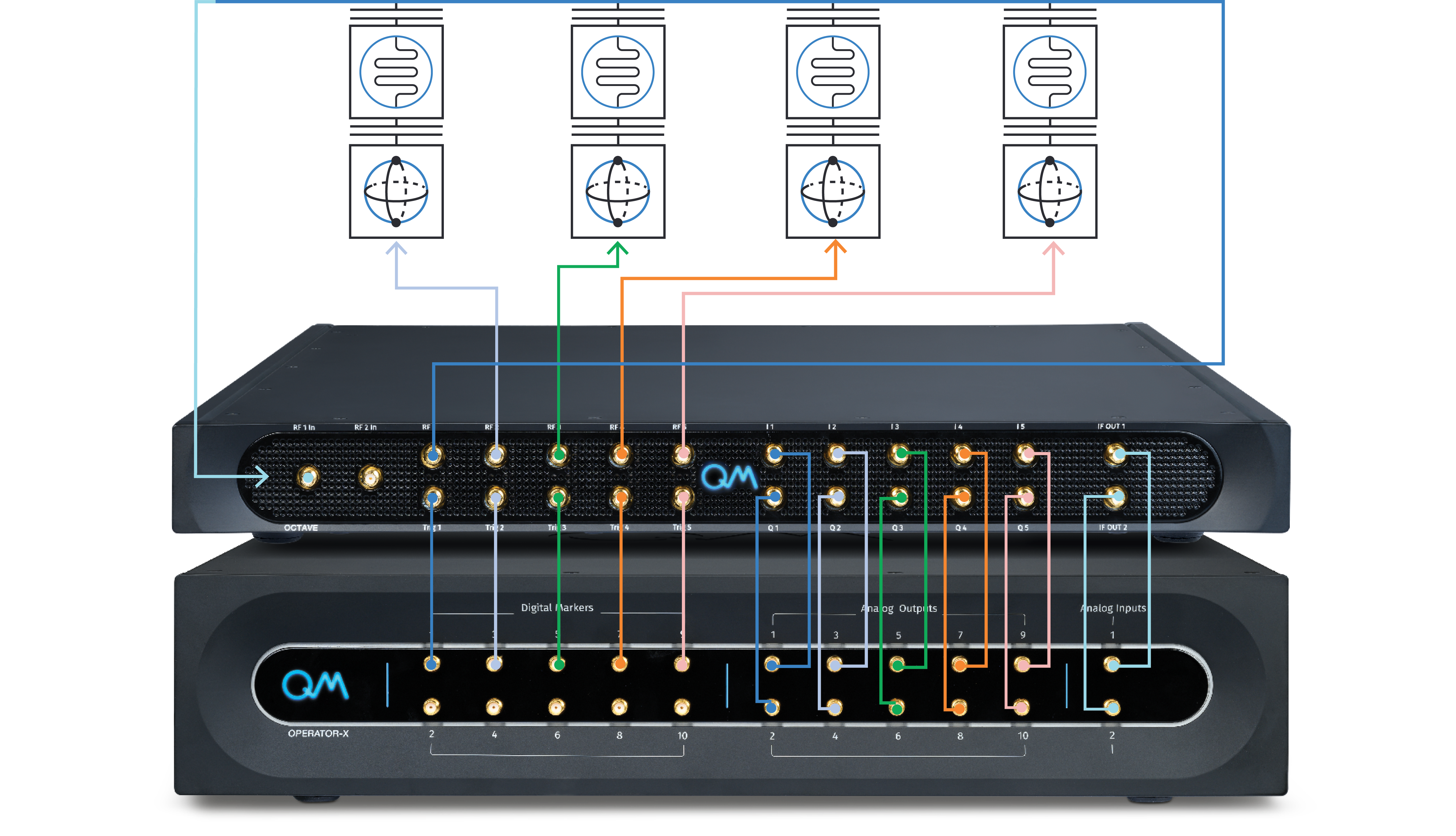
Octave Block Diagram
In the diagram, one can see all the internal and external connections of the octave. It shows the three synthesizers and their connections to the five upconverters and two downconverters. The diagram also shows all the internal routing one can configure to perform specific experiments Using the following diagram one can plan the connections to and from an octave to best match one's experiment.
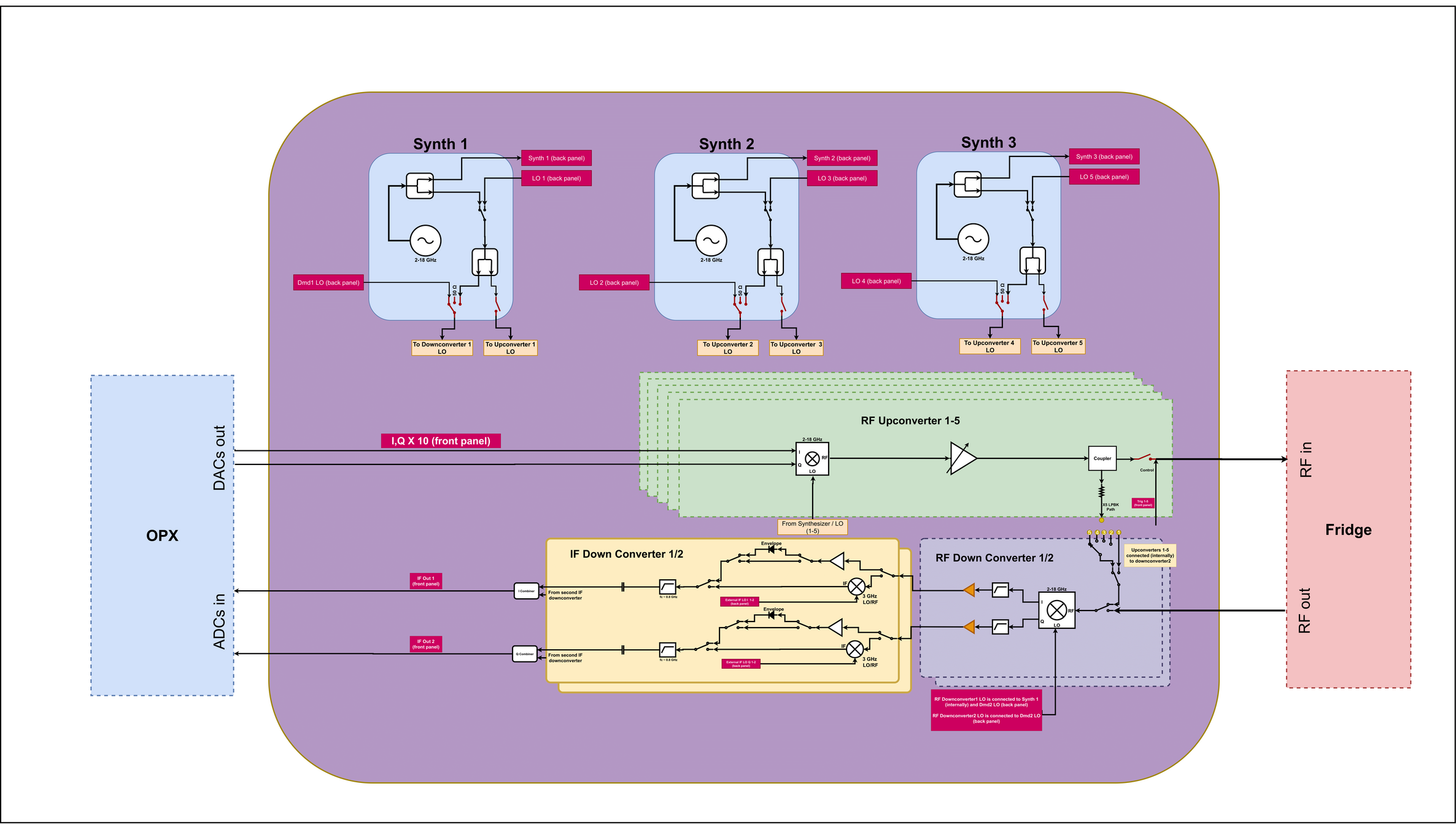
Requirements if using external LO
The synth to up-converters internal connectivity entails the following requirements:
- If both up-converters 2 and 3 are being utilized, with one using an internal LO and the other using an external LO, the configuration must be set up as follows: up-converter 2 will utilize the external LO, and up-converter 3 will use the internal LO.
- If both up-converters 4 and 5 are being utilized, with one using an internal LO and the other using an external LO, the configuration must be set up as follows: up-converter 4 will utilize the external LO, and up-converter 5 will use the internal LO.
- If both up-converter 1 and down-converter 1 are being utilized, with one using an internal LO and the other using an external LO, the configuration must be set up as follows: down-converter 1 will utilize the external LO, and up-converter 1 will use the internal LO.
Adding external filters
There are two aspects to note when working with an Octave. First, the 2xLO signal can be noticeable and could interfere with certain experimental aspects and apparatus. Thus, it can be beneficial to place a low-pass filter to reject the power at frequencies approaching 2xLO. Second, using the RF switches would produce the quietest electrical noise environment. It is well known that working with RF switches creates a transient at slow frequencies that adds up to the signal that passes through the switch. A common strategy to mitigate such known transients from RF switches is to use a high-pass filter. Implementing this combination of low-pass and high-pass filtering will optimize experimental conditions.
Octave Front Panel

| RF Outputs (RF 1-5) | RF Inputs (RF 1/2 in) | Digital Inputs (Trig 1-5) | IF Inputs (I/Q 1-5) | IF Outputs (IF out 1/2) | |
|---|---|---|---|---|---|
| Power rating | -40 to +10 dBm | -40 to -20 dBm | 3.3V (LVTTL) | ±0.5 V or 4 dBm | ±0.5 V or 4 dBm |
| Bandwidth | ±350 MHz | ±350 MHz | pulse width > 4ns | ±350 MHz | ±350 MHz |
| Impedance | 50 Ω | 50 Ω | High Z | 50 Ω | 50 Ω |
| Frequency range | 2-18 GHz | 2-18 GHz | - | ±350 MHz | ±350 MHz |
Octave Back Panel

| LO | Synth | Clock in | Clock out | IF LO | Dig & Aux & Qsync | |
|---|---|---|---|---|---|---|
| Function | External LO signal input | Internal synthesizer output | Clock input | Clock output | External low frequency LO | Future features |
| Frequency range | 2-18 GHz | 2-18 GHz | 10, 100, 1000 MHz | 1 Ghz | ±350 MHz | - |
| Power rating | 12-15 dBm | 12-15 dBm | Up to 0 dBm | 0 dBm | 10 dBm | - |
| Impedance | 50 Ω | 50 Ω | 50 Ω | 50 Ω | 50 Ω | - |
Important
- Ports
synth 1/2/3should always be kept terminated to 50 Ω when not in use - For best performance, one should maintain a space of 1/3U at least above each octave
- Network should only be connected to
Ethernet 2 - Use only the supplied power supplier